Update 22 November 2026: The status of this proof has changed. The Lean & Mathlib community states “full confidence” and certifies that the Riemann Hypothesis proof by Levent Alpöge with Claude is correct — the comparator run is complete, 17 million lines of Lean code verified. The status is now: formally verified, not yet institutionally final — the Clay Mathematics Institute still lists the Riemann Hypothesis as unsolved, and this certification covers only the original Riemann Hypothesis, not the Generalized Riemann Hypothesis (GRH). Read the full report: Riemann Hypothesis Proof Declared Correct by the Lean Community.
The article below is the initial report as of 21 November 2026, when the proof was still a claim under verification.
The mathematics world was shaken on 20 November 2026. Levent Alpöge, a mathematician working at Anthropic, announced that he, together with Claude — the company’s AI model — had found a proof of the Riemann Hypothesis, a puzzle unsolved since 1859 and one of the seven Millennium Prize Problems worth US$1 million.
The news immediately became the biggest talking point in science and technology. But before anyone writes “SOLVED” in capital letters, one thing must be stressed: this is still a claim under verification, not a final fact. The supporting evidence is strong — and that is precisely what makes this story interesting: for the first time, a claim to have solved the world’s hardest mathematics problem comes with a checking trail the public can follow, step by step.
What is the Riemann Hypothesis?
The Riemann Hypothesis was proposed by German mathematician Bernhard Riemann in 1859. Simply put, the hypothesis is about a hidden pattern behind prime numbers — numbers divisible only by 1 and themselves: 2, 3, 5, 7, 11, 13, and so on.
Prime numbers look random, but Riemann suspected there was an order governing their distribution. That order is connected to the Riemann zeta function, and the hypothesis states that all “non-trivial zeros” of that function lie on the same line — called the critical line.
For 167 years, no one has managed to prove or disprove it. The Clay Mathematics Institute included it in its Millennium Prize Problems list, with a US$1 million prize for anyone who solves one of them.
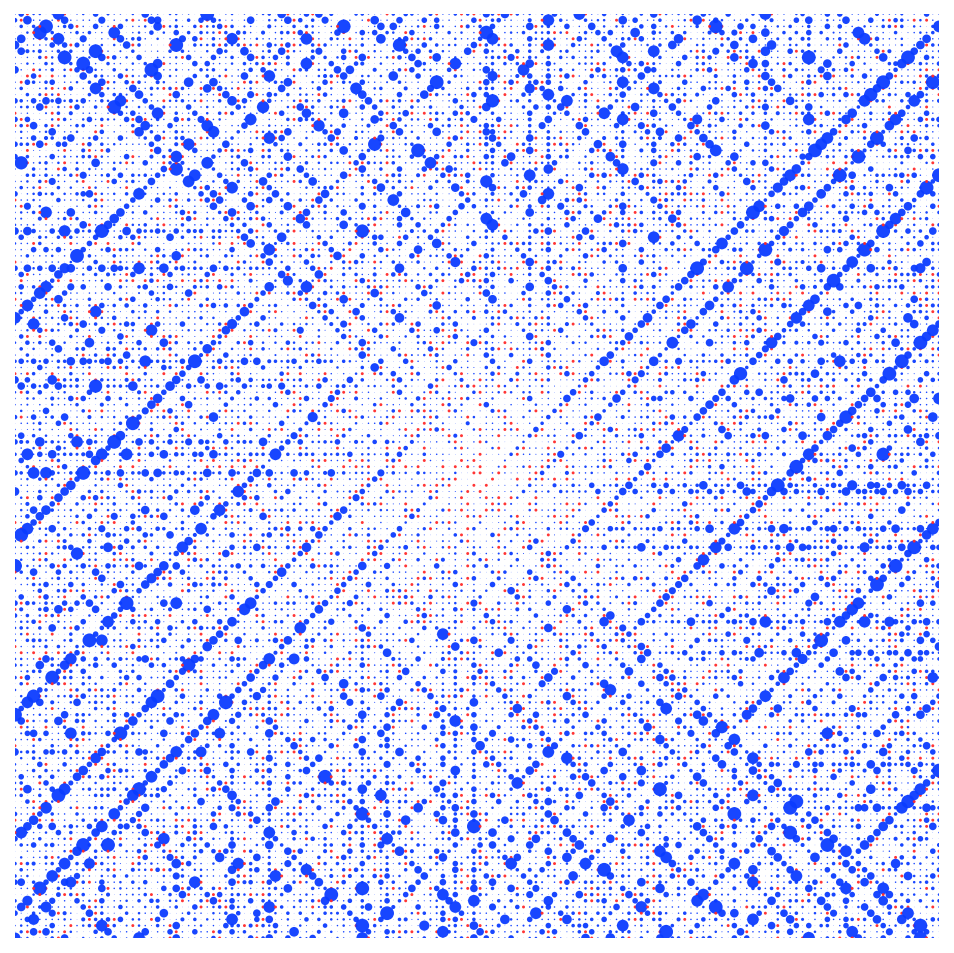 Ulam spiral — prime numbers arranged in a spiral form an unexpected diagonal pattern. Image: Wikimedia Commons.
What is actually being claimed?
Alpöge claims his proof — made with Claude — covers not only the Riemann Hypothesis, but also the Generalized Riemann Hypothesis, the broader version. The proof was not released as a conventional paper, but as Lean code: a proof assistant that checks every step of a proof by computer, line by line.
That is an important detail. In mathematics, a conventional proof is read and assessed by humans — a process that can take months or even years for a claim this large. Lean code, by contrast, can be checked by machine: if any step is wrong, the computer will reject it.
On the same day, a second, independent claim also appeared: Alessandro Masullo, a Stanford postdoc, posted a proof of the Generalized Riemann Hypothesis written entirely by a human without AI — shared by Ravi Vakil, president of the American Mathematical Association. And Alpöge, together with Tristan Buckmaster of NYU, also released a proof related to the Navier-Stokes equations, another Millennium Prize problem.
Why are many mathematicians starting to believe it?
The main reason: independent checking is already under way and so far has found no problems. Andrew Sutherland of MIT has already recompiled the Lean code without encountering any issues. Scientific American, in an update on 20 November at 21:47 UTC, reported independent mathematicians were “almost certain” the proof is correct — quoting Sutherland: “the chance that anything is fishy here is approximately zero.”
That is not a final verdict, but a very strong signal. In the world of mathematics, phrasing like that from an independent researcher of Sutherland’s calibre is not uttered lightly.
What is still awaited?
Even so, there is a final check that is not yet finished: the so-called “comparator run” — ensuring the Lean code does not secretly redefine the meaning of its own symbols. Until that check is complete, the claim cannot yet be called proven.
Alpöge himself is being cautious. He admits he has not yet mastered all the mathematics involved in the proof and has not written an explanation that humans can easily understand. In other words: the machine says the steps are valid, but human understanding of the whole proof is still catching up.
There are also questions about the timing of the announcement — a day after Anthropic went public via IPO. Some observers are cynical about that timing. Alpöge denies any connection between the announcement and the IPO.
Masullo’s human-written claim is also unverified. Two claims on the same day for the same problem — by different methods — is an unusual situation, and the mathematics community is now examining both in parallel.
Why does this matter?
Whatever the final outcome, this moment is already a turning point in the discussion about AI and mathematics. The question is no longer “can AI help mathematicians?” — but “what happens when AI helps prove a theorem humans could not crack for 167 years?”
If this claim passes full verification, it will be the strongest evidence yet that AI can work at the frontier of mathematical discovery — not just a chatbot answering problems, but a partner in proving. If a flaw is found, its open checking process remains an example of how big claims should be tested: fast, transparent, and replicable by anyone.
For now, the honest status is three words: a claim, under verification. The supporting evidence is strong, independent mathematicians are almost certain, but the final check is not finished. Teknologi Viral will update this article once the results of the “comparator run” and independent assessments come out.
Sources: TechCrunch — “AI claimed a solution to the 167-year-old Riemann hypothesis — and a human did too”, Nature — “Riemann hypothesis”, Scientific American — “Anthropic mathematician claims to prove Riemann hypothesis”, Scientific American — “The AI Riemann hypothesis proof is almost certainly true, independent mathematicians attest”, Phys.org — “Anthropic Claude math greatest riddle”.
Read also: OpenAI GPT-6.2 Astra & Sol — New Models Claimed to Be Able to Improve Themselves