
The short answer: some of it is already possible, some of it is still fiction. Researchers can indeed read dream content from brain activity, reconstruct images a person has seen, and even turn fragments of a dream into a short video. Two people have even exchanged messages while both lucid dreaming. But there is no device that records dreams the way a video camera records events — and claims that sound like that deserve suspicion.
The distinction matters. There are three different things that are often mixed up: reading the category of dream content from brain signals, reconstructing images from brain activity, and communicating inside a lucid dream. All three are real within certain limits — but none of them means your dreams can be replayed like a film.
2013: dream content first read from the brain
The first serious step came from Japan. In 2013, a research team from ATR Computational Neuroscience Laboratories in Kyoto — Tomoyasu Horikawa, Masako Tamaki, Yoichi Miyawaki, and Yukiyasu Kamitani — published a study in the journal Science titled “Neural Decoding of Visual Imagery During Sleep”.
The method: three volunteers slept inside an fMRI scanner while their brain waves were monitored with EEG. As soon as the EEG showed they were entering the early stages of sleep — when dream-like imagery starts to appear — the researchers woke them and immediately asked them to describe what they had just “seen”. Those reports were matched with the brain activity recorded just before.
The result: a computer could guess the category of objects appearing in the sleep imagery — people, cars, streets, text, and around 20 other categories — with accuracy above chance. The key finding: patterns of brain activity when dreaming of an object resemble the patterns when seeing the same object while awake. That is what makes it possible to use data from awake people to train a dream-reading model.
But the limits must be noted: what was read was the category of objects, not the dream itself. There was no video, no recording. And participants were woken during early sleep (the hypnagogic phase), not during deep REM sleep — the phase when dreams are most vivid.
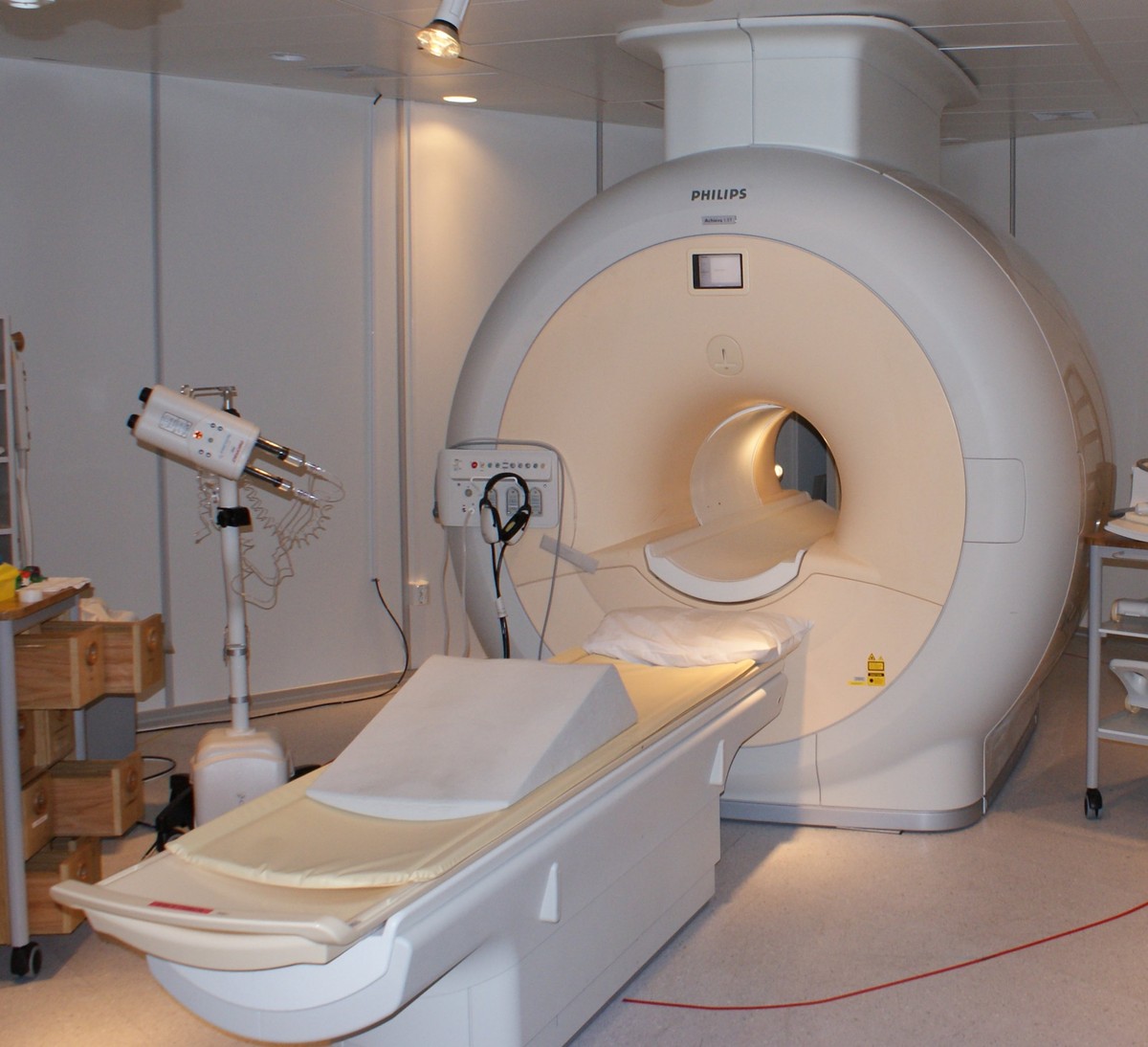 An MRI scanner like this is used to record brain activity during sleep and waking. Photo: Jan Ainali, Wikimedia Commons (CC BY 3.0).
2023: AI redraws what the brain sees
The next leap came a decade later, also from Japan. In 2023, Yu Takagi and Shinji Nishimoto of Osaka University published a method pairing fMRI scans with Stable Diffusion — the same AI image-generation model used to create images from text.
They used data from the Natural Scenes Dataset: four people viewed more than 10,000 images inside a 7-Tesla fMRI scanner. The AI model then learned to connect patterns of brain activity with the image being viewed — and could reconstruct new images from brain signals alone, with surprising detail: a train, a teddy bear, a clock tower, and a skier could be recognised again from the reconstructions. In two-way identification testing, the reported accuracy reached around 80 percent.
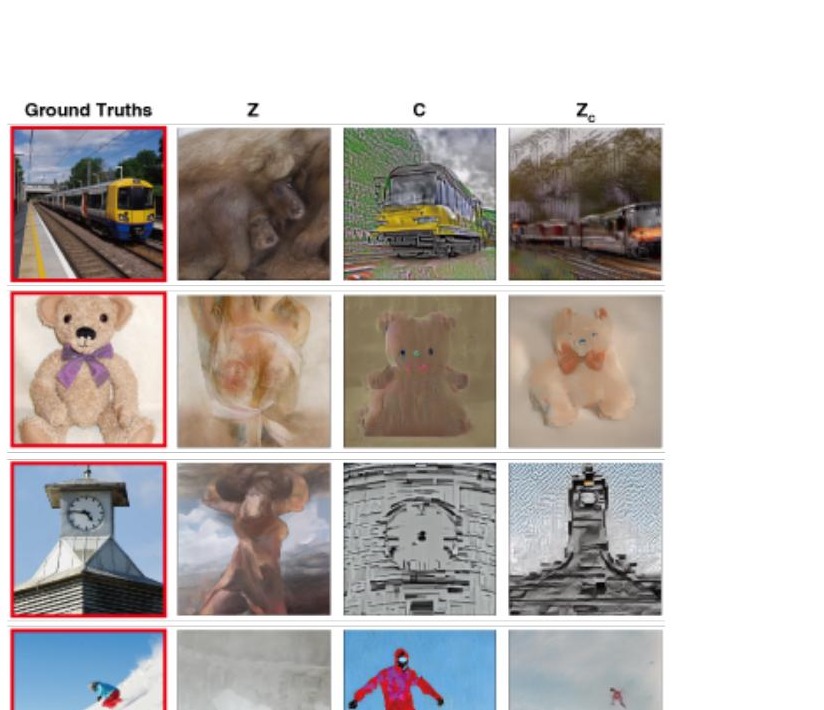 Original image (red box) and reconstruction from brain activity by Takagi & Nishimoto. Columns z, c, and z_c are three variants of the reconstruction method. Image: Takagi & Nishimoto, CVPR 2023 / bioRxiv (CC BY 4.0).
What needs correcting: this research reconstructed images seen by people while awake, not dreams during sleep. And the machine is not a home device — a 7-Tesla fMRI scanner is a giant machine costing billions of rupiah, and the model must be trained specifically for each person with thousands of images. So this is strong proof of concept, not a product you can buy.
2024: two people exchange messages while dreaming
The most viral claim came from California neurotechnology company REMspace. On 24 September 2024, the company announced that two people had successfully exchanged messages while both were in a lucid dream — the state in which a person realises they are dreaming.
The system works through an artificial language called Remmyo. When the system detects the first participant entering a lucid dream, a random word — “Zhilak” — is sent via earbuds. The participant repeats the word inside the dream, and their facial muscle movements are captured by EMG sensors, translated by software, then stored on a server. A few minutes later, when the second participant enters a lucid dream, the message is forwarded to them via earbuds — and they confirm it after waking.
Details from the team’s preprint paper: seven experienced lucid dreamers took part in the experiment over two nights, producing 10 lucid dream episodes long enough to use. Human-to-human messages were successfully sent twice; messages from the server were heard six times; and there were four signal misreads.
What is often lost from the coverage: this is not a live conversation. The two people were not dreaming at the same time, were not in the same dream, and there was no telepathy. This is store-and-forward messaging between separate dream episodes — with a gap of around eight minutes. And as of the announcement, the research had not passed peer review; the company said it had submitted it for review. The video circulating at the time was a visualisation, not a recording of the experiment.
2025: dreams turned into short videos
The latest development comes from China. In 2025, Yanwei Fu of Fudan University and colleagues published a framework that trained a model called NeuroPictor on fMRI data from eight people viewing thousands of natural scenes. Then they collected fMRI data from three participants while sleeping, and succeeded in reconstructing image fragments from three dream segments the participants remembered well.
The next step went further: with the help of a large language model (LLM), those fragments were arranged into a narrative and processed into a short video — complete with a storyline written based on the order in which images appeared in the dream. According to a report in Communications of the ACM, the resulting videos were judged consistent with the participants’ descriptions of their dreams.
But note the wording: “fragments” and “an arranged narrative”. This is not a recording of a dream. The model guesses images from brain patterns, then AI writes a story to tie them together. The same team also documented in 2025 a way to align fMRI and EEG recordings — a step towards decoding dreams at home with an EEG cap far cheaper than an fMRI scanner, though that too is still a research plan, not a product.
Meanwhile, the research foundations are also getting stronger: in 2025, a consortium of 53 researchers from 37 institutions in 13 countries released DREAM, the largest dream database ever — more than 2,600 records from 505 participants, containing EEG recordings and dream reports — enabling AI to predict whether or not a dream occurred from brain activity with accuracy above chance.
Prophetic Halo: a promised device, never delivered
In the consumer product space, the name that comes up most often is Prophetic Halo — a headband claimed to use focused ultrasound to trigger lucid dreams. The device was announced in 2023 with a planned spring 2025 delivery. The reality: Halo was never shipped.
The company then replaced its product line with two new headbands, Dual (US$449, scheduled for late 2026) and Phase (US$1,299, mid-2027), announced in April 2026. To date there is no peer-reviewed study proving these devices work — the evidence the company shows comes from surveys of its own beta testers. The founders even admitted to Slate that at the time they had not succeeded in triggering a single lucid dream with the device.
This pattern is worth remembering: a big announcement, a delivery date that slips, then a replacement product with new promises. For consumers, that is reason to wait for independent evidence before ordering.
So, can dreams be recorded like video?
With all the evidence above, the answer can be summarised in three levels:
What is already possible: reading the category of dream content from brain signals (since 2013), reconstructing rough images from brain activity while awake (since 2023), and sending coded messages between lucid dream episodes (2024). In 2025, dream fragments could even be turned into AI-based short videos.
What is not yet possible: recording a dream as it is — complete with flow, sound, and detail — the way a camera records an event. All “dream videos” today are AI reconstructions and interpretations, not recordings.
What is still far off: a home device that records dreams every night. The obstacles are not just the scanner’s price, but also the need to train a model for each individual brain, and the fact that dreams have no “ground truth” to check against — what a person remembers after waking is only a small part of their dream. According to the book Finding Meaning in Dreams, humans are estimated to dream four to six times a night, but remember less than 10 percent.
There is also a privacy question. If the contents of thoughts and dreams can be read by machines, who has the right to access them? The researchers themselves stress the need for ethical rules before this technology leaves the laboratory.
Why this matters for readers in Indonesia
First, do not readily believe products that claim they can “record your dreams like video”. To this day, no consumer product can do that — what exists are lucid dream trigger devices whose effectiveness is unproven, and laboratory research that still needs giant scanning machines.
Second, for those interested in experiencing lucid dreams, the method with the best evidence so far is actually free: the MILD technique — training yourself to remember dreams and realise you are dreaming — combined with waking briefly in the early morning. No device has been proven in independent research to reliably trigger lucid dreams.
Third, the direction of research is real and moving fast. From reading object categories in 2013, to reconstructed images in 2023, to dream narrative videos in 2025 — the distance between “reading dreams” and “watching dreams” is indeed narrowing. But narrowing is not the same as arriving. Until there is evidence that can be replicated and independently tested, dreams remain the most private territory inside our heads — and for now, only we ourselves can watch them.
Sources: Horikawa et al., “Neural Decoding of Visual Imagery During Sleep”, Science (2013), Takagi & Nishimoto, “High-Resolution Image Reconstruction With Latent Diffusion Models From Human Brain Activity”, CVPR 2023, bioRxiv 10.1101/2022.11.18.517004, Raduga & Shashkov, “Server-Human and Human-Human Communication in Lucid Dreams” (preprint, ResearchGate), Tom’s Guide — REMspace, Communications of the ACM — “Decoding Dreams with AI”, Fu et al., “Making Your Dreams A Reality” (arXiv, 2025), Huo et al., “NeuroPictor” (arXiv, 2024), PsyPost — DREAM dream database, FutureNow — lucid dream devices, Smithsonian Magazine — image reconstruction from brain scans.
Read also: OpenAI GPT-6.2 Astra & Sol — New Models Claimed to Be Able to Improve Themselves