Tesla has begun rolling out Full Self-Driving (FSD) v15 — the biggest update to its autonomous driving system in the past year — with one feature that immediately steals attention: a new driving display that looks like a video game.
Tesla announced the launch on its official X account on 21 November 2026. The first wave of customers has already received the update, and a wide rollout is targeted for December 2026. Elon Musk shared the announcement with the comment “It’s like GTA” — referring to the game Grand Theft Auto.
“Reality View”: seeing what the car plans
The most striking feature of v15 is “Tesla Reality View” — called “Tesla Augmented Reality” in the official release notes. The car’s centre screen now shows a real-time generative visualisation from a virtual camera above the car: the road around the vehicle is rendered in detail, complete with the turning plans and parking spots FSD has planned.
Tesla says drivers can “see and control” the FSD plan — including tapping a displayed destination point. This new visualisation replaces all the model signals previously shown separately, becoming a single end-to-end display claimed to use less computing.
If it works as advertised, Reality View could make supervising the system far easier: drivers no longer have to guess what the car will do, but see it directly on screen.
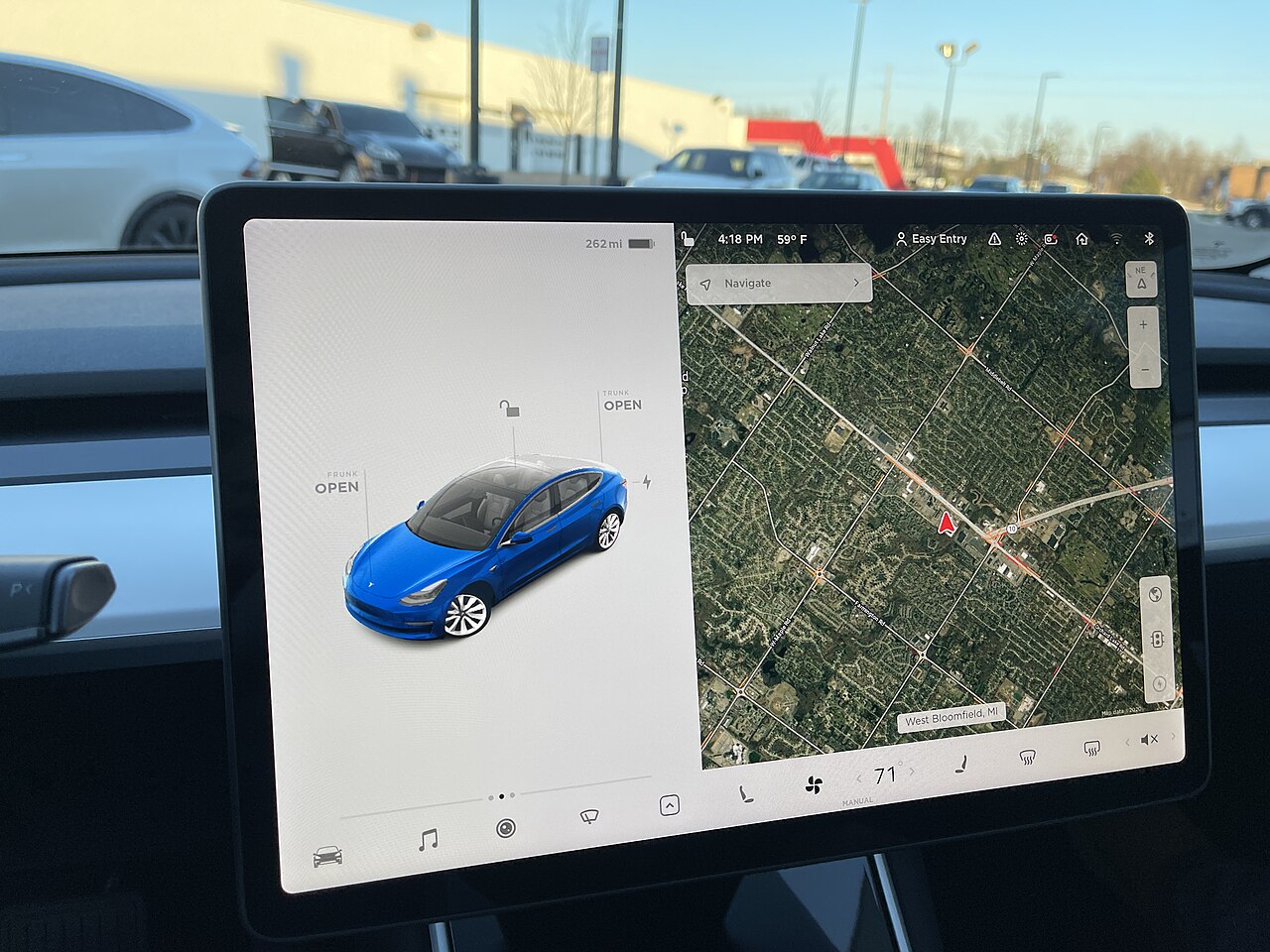 Tesla Model 3 touchscreen. In FSD v15, this screen shows “Reality View” — a generative visualisation of the driving plan. Photo: Wikimedia Commons, CC BY-SA 4.0.
The 25x claim — with no baseline figure
Behind the visuals, Tesla makes a big claim: a new vision encoder — shared by FSD, Robotaxi, and the Optimus humanoid robot, and trained from millions of internet videos — improves the “critical intervention rate” by 25 times.
What must be noted: Tesla did not publish its baseline figure, only the multiplier. “Critical intervention rate” is itself the right metric for measuring progress towards unsupervised driving — how often the driver must take over in critical situations — but without the starting figure, the 25x claim is hard to verify independently.
Electrek, which covered the launch, calculates: their data from early this year showed FSD v14 could travel several thousand miles between critical interventions. A 25x improvement on that figure would place v15 at around 50,000 miles between critical interventions — far beyond the around 10,000 miles long cited as a requirement for limited unsupervised service. If true across the whole fleet, this would be Tesla’s most meaningful push towards full autonomy in a long time.
But FSD’s history gives reason for caution. Every major version has brought real progress along with new problems, and periodic updates often actually regress. When v14 arrived in October 2025, it came with hallucinations, sudden braking, and speeding — early data showed around 732 miles between critical disengagements, below expectations. Tesla has also not published disengagement data that could settle this debate.
Targeting the most complained-about weaknesses
What stands out in the v15 release notes is their aim: almost every fix targets the areas owners and regulators complain about most.
Sign detection. In testing published last September, Brussels non-profit Johanna.be found FSD exceeding the speed limit in 55% of the 30 km/h zones it passed through, averaging 44 km/h — and the car’s screen displayed a 50 km/h limit. The car was not reading the signs.
Potholes and puddles. FSD is now claimed to detect potholes, road surface details, and avoid deep puddles. Last August Musk said pothole avoidance was “coming soon” — something he has promised since 2019.
School zones and speed cameras. FSD now handles per-driver-profile speeds, school zones, and speed limits better — and can slow down when approaching speed cameras. The context: NHTSA (the US road safety regulator) is reviewing a petition alleging Tesla Robotaxis speeding in active school zones, alongside an investigation opened in October 2025 into FSD traffic violations such as running red lights.
Parking and driver monitoring. Parking location selection now uses personal parking history, and the map shows several parking options at the destination. Camera-based driver monitoring is now more available when drivers wear hats and sunglasses. There is also Bike Rack Mode, which lets FSD run with a bike rack or similar trailer accessory.
One change actually loosens things: Tesla “reduced the strictness” of driver monitoring on high-speed profiles — at a time when drivers falling asleep with FSD active keep making the news, and Tesla is tightening monitoring in Europe at regulators’ request.
Still “Supervised”
Whatever the claims, FSD’s status has not changed: Full Self-Driving (Supervised). Drivers must remain alert and ready to take over at all times.
Last April, Musk wrote that v15 “will go far beyond human safety levels, even in unsupervised and complex situations.” He said similar things about v12 and v14. In August, Tesla told JPMorgan that v15 is a “step-change” built on seven “core technologies”, with around 40% of them already running in the Robotaxi fleet in Austin.
The visuals have proven impressive — that can be judged directly from the video Tesla shared. The driving side is harder to assess: “better detection” does not explain how much better, and a 25x multiplier without its baseline figure is hard to verify. If v15 genuinely fixes all the weaknesses it targets, this is a very good update. That proof is now on the road — and in the hands of first-wave drivers.
Read also: AI stocks plunge: largest IPO in history, Nasdaq −5.28%, Nvidia −14%.